
TAP Network at CSW70: Reflecting on a Historic Commission, Defending Multilateralism, and Advancing People-Centered Justice
As the 70th Session of the Commission on the Status of Women has now come to a close, we want to extend our deepest gratitude to each of you who joined us, in person in New York or online from around the world, to advance people-centered, feminist, and justice-oriented policies and visions at this critical moment for the rights of women, girls and gender-diverse people.
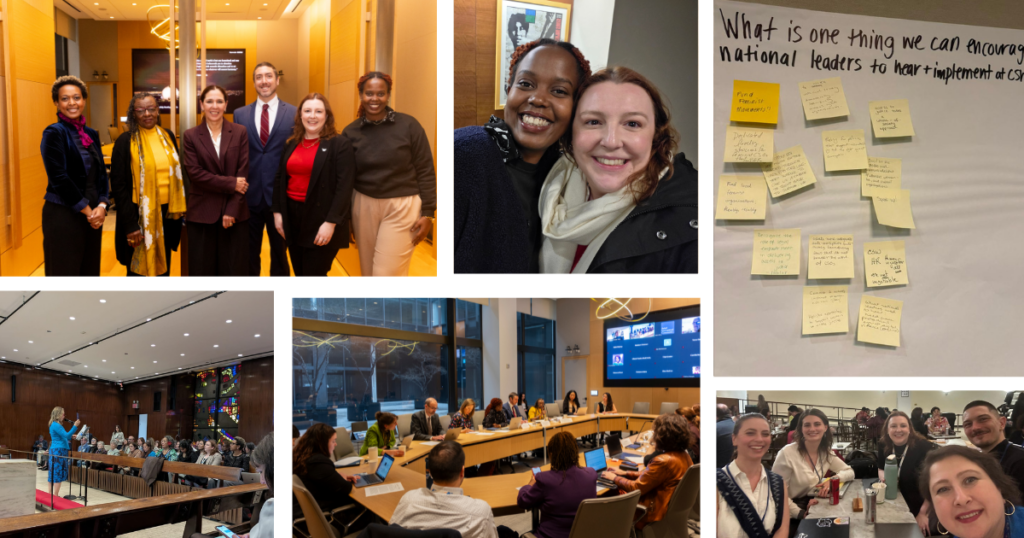
This year’s CSW was unlike any iteration before, taking place at a time of mounting geopolitical tensions, conflict, and rising threats to civic space and gender equality. The overwhelming contributions from civil society actors, activists, and feminist movements showcased the commitment to resistance both on the ground and through multilateral decision-making and international law. Despite the many challenges civil society faces working at the intersection of peace, justice, human rights, and accountability, our engagements across CSW70 highlighted the stories of resilience and success, and featured a strong evidence base to support the calls for greater investment in peace, justice, and feminist leadership. Read on for more insights from our events, including features from TAP Network members.
TAP’s Parallel Events: Key Takeaways
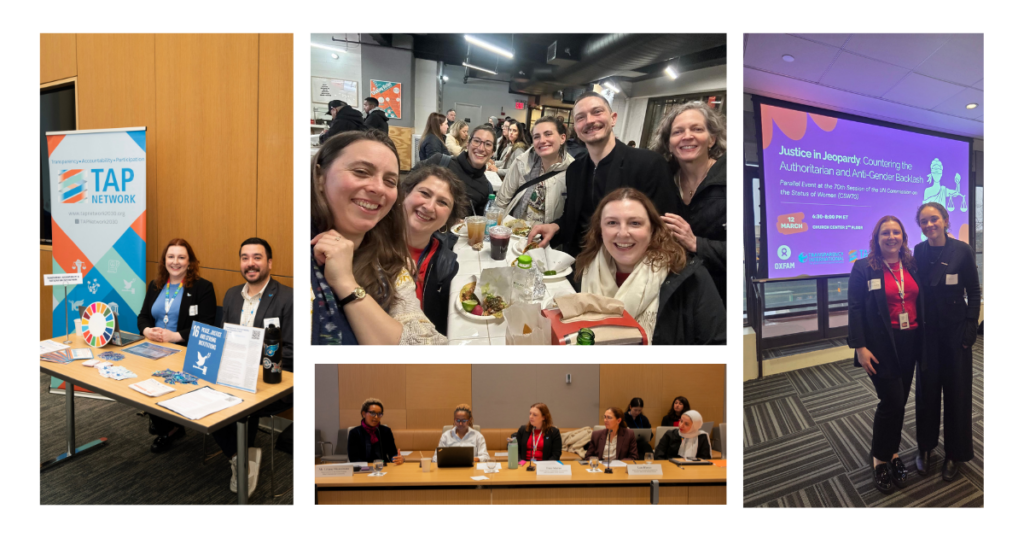
This year, TAP Network organized two parallel events that brought together diverse voices from across our network, highlighting the intersections of peace, justice, women’s human rights, and gender equality:
“The Cost of Rising Militarization: Justice, Gender Equality, and Peace at Risk” (March 12)
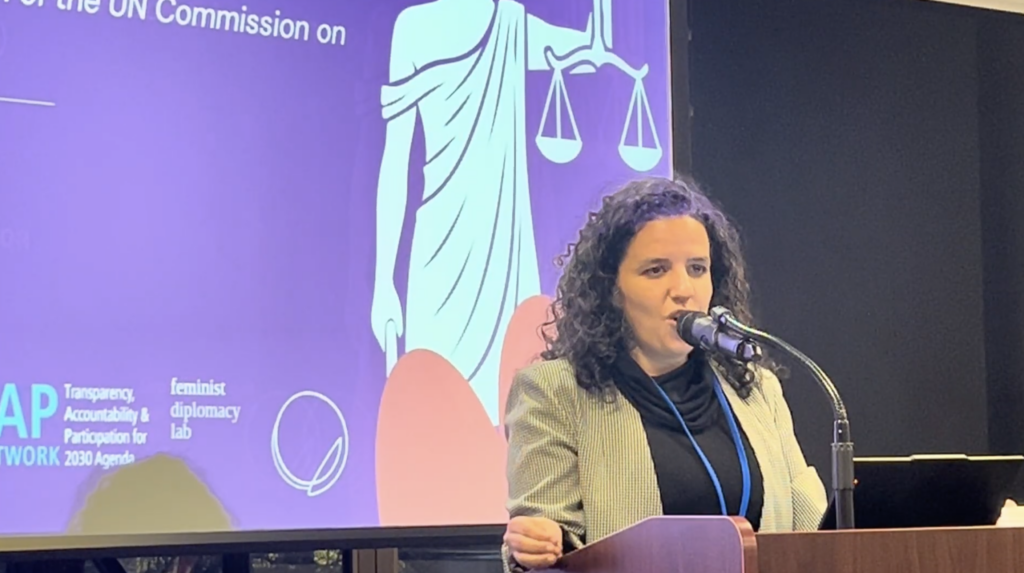
This hybrid panel (co-organized by the TAP Network, Baha’i International Community, and the Women’s International League for Peace and Freedom (WILPF)) examined an urgent trend undermining SDG 16 and gender equality: the rise in global military spending at the expense of financing for justice, legal aid, and peacebuilding.
Both in-person and online, panelists made a powerful case that sustainable peace is built through justice, inclusion, and trust—not force—and that increased militarization diverts critical resources away from the very systems women depend on for safety, accountability, and justice. Panelists further articulated the need to think creatively about building political will to support calls for rebalancing spending, and develop narratives that resonate with not only decisionmakers at national and global levels, but also people around the world that hold the power to call upon their governments to invest in peace and development rather than security and defense.
Key takeaway: Justice is central to sustainable peace. Without investment in people-centered justice systems, there can be no gender equality or lasting peace. Governments and institutions must rebalance priorities and our budgets, and think creatively about narratives that support this.
TAP Partner Spotlight:
This event featured Leonie Mutoni, Director of Programs at the Legal Aid Forum Rwanda, secretariat for the Africa-Center of Excellence for Access to Justice (ACE-AJ), a longtime TAP partner. Leonie shared her thoughts on what next steps must come from CSW70:
- “Access to justice must be treated as a core financing issue, not only a legal or governance concern. Governments and donors should explicitly allocate sustained funding to frontline justice services as part of development and peacebuilding budgets.
- Scale up investment in community-based mechanisms as proven cost-effective models that reach women and girls most effectively.
- Move away from fragmented, short-term funding cycles toward long-term, predictable financing models that allow legal aid providers to maintain capacity and continuity of services.
- Recognize and fund legal aid systems as essential infrastructure for peacebuilding, not as peripheral social services.
- Design funding priorities around the actual access barriers faced by women and girls, ensuring services are physically, financially, and socially accessible”
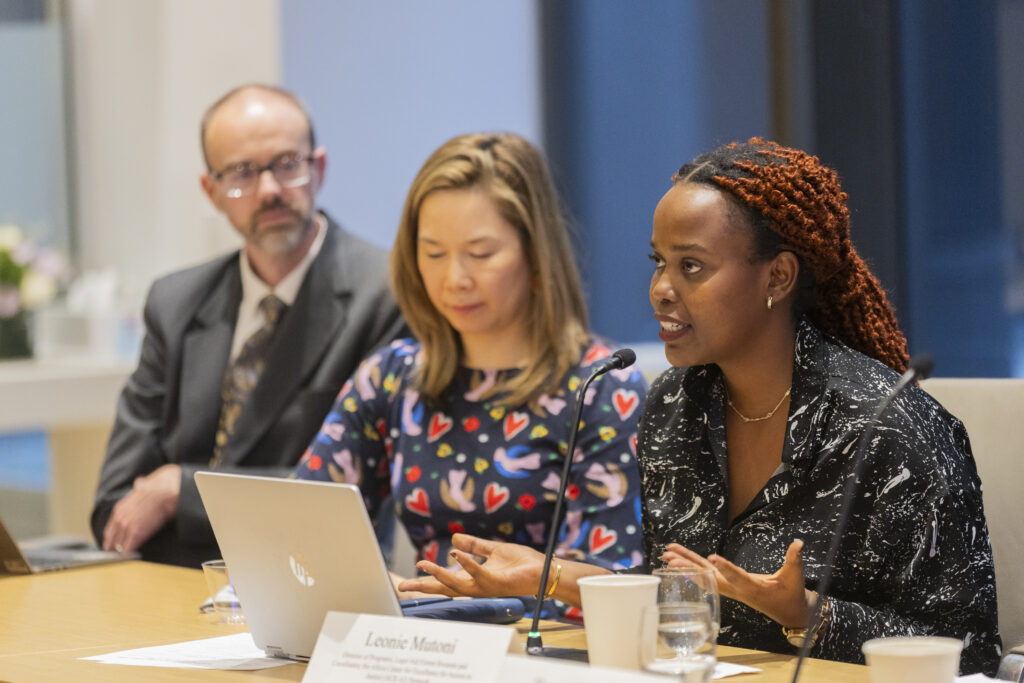
Photo credit: Baha’i International Community
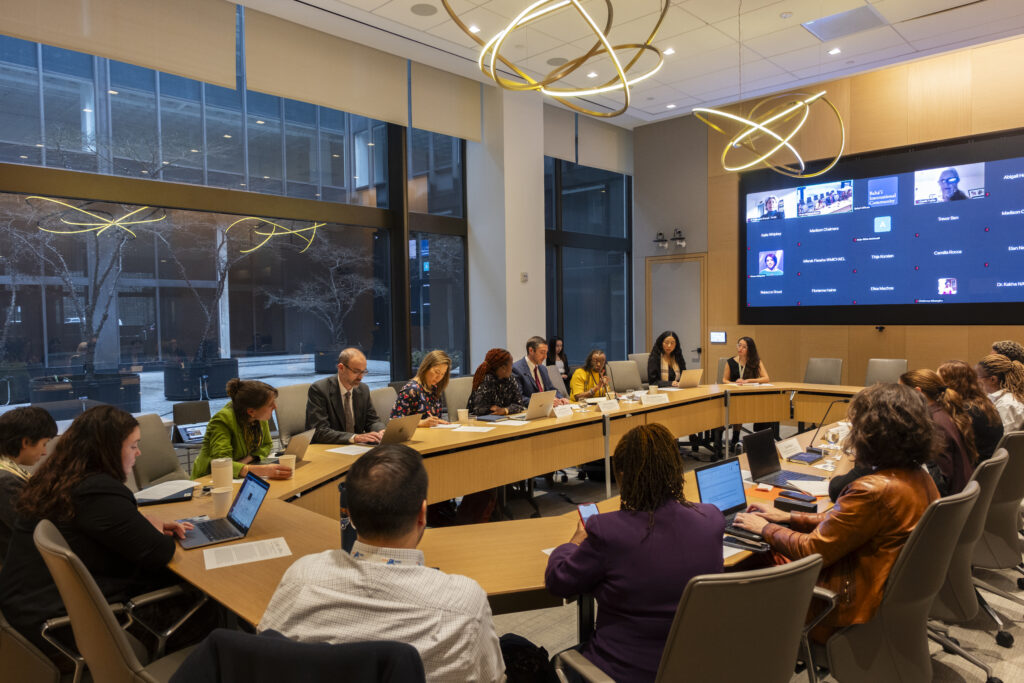
Photo credit: Baha’i International Community
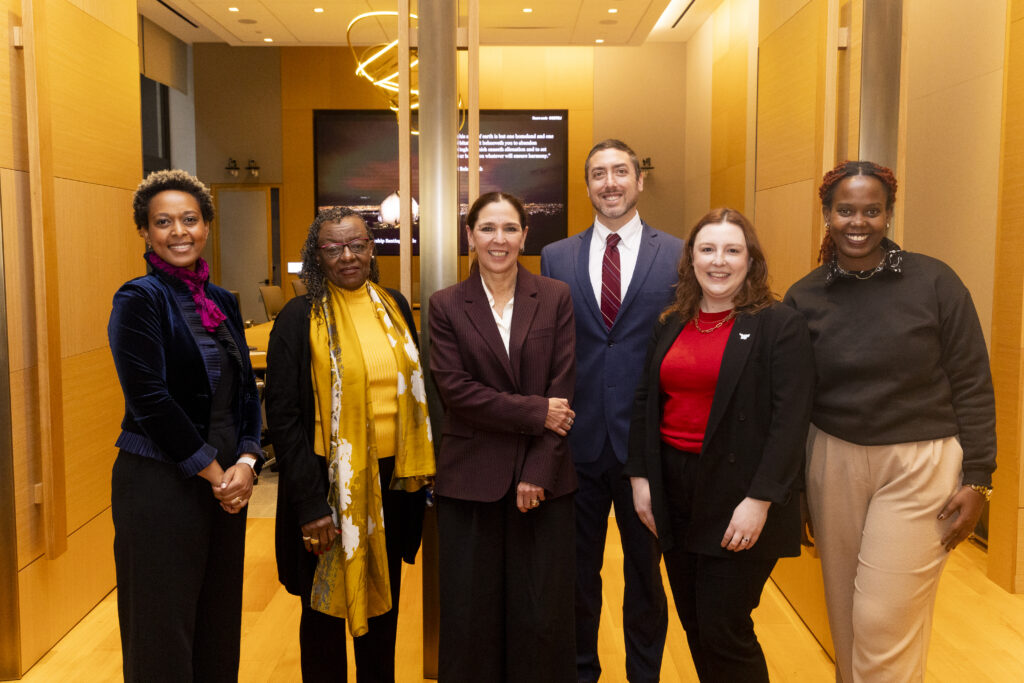
Photo credit: Baha’i International Community
“Justice in Jeopardy: Countering the Authoritarian and Anti-Gender Backlash” (March 12)
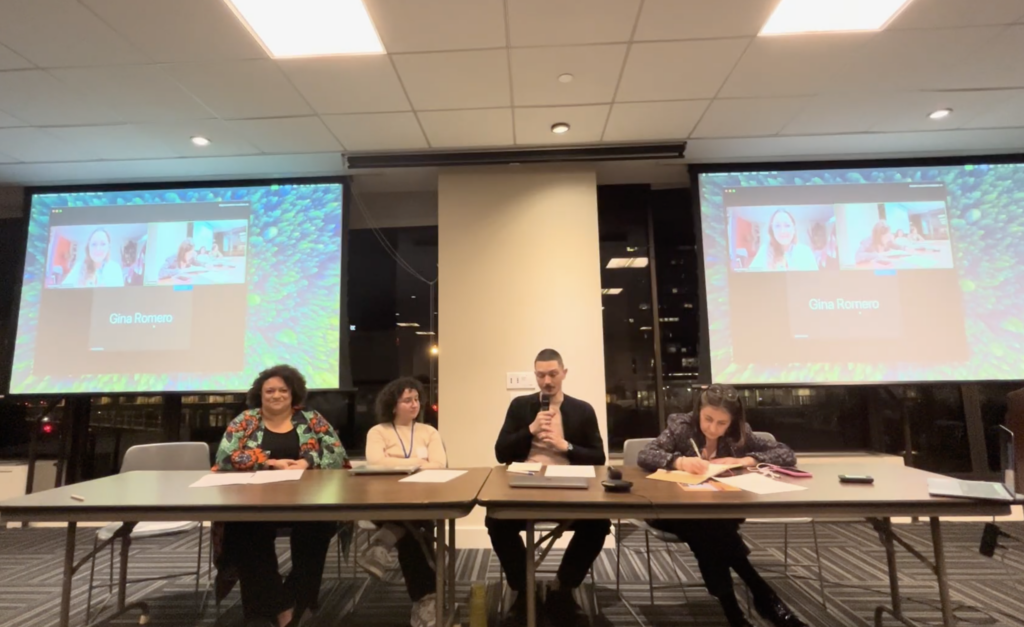
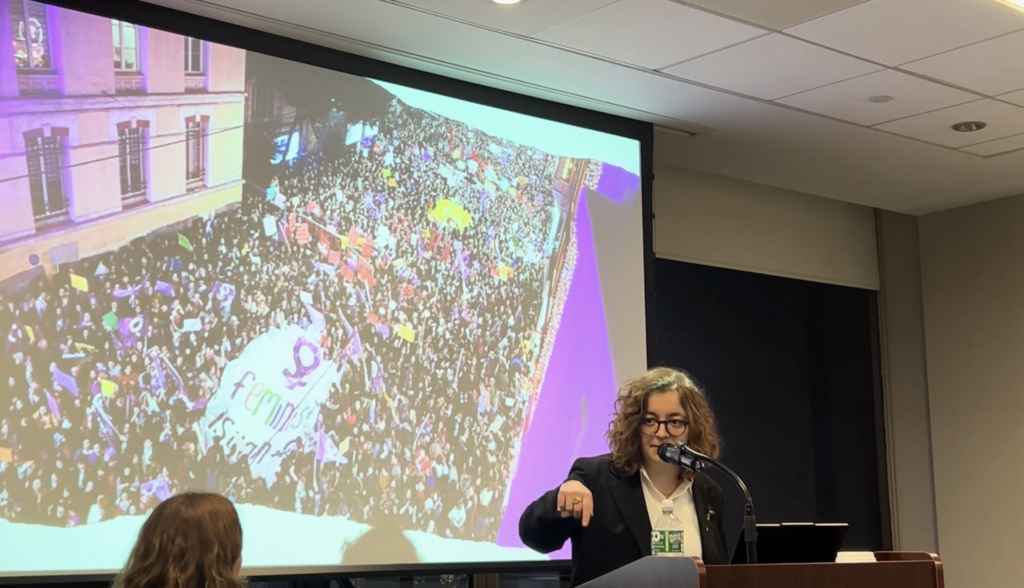
In this evening session (co-organized by the TAP Network, Feminist Diplomacy Lab, OXFAM, and Transparency International), we confronted the dual threats of rising authoritarianism and expanding anti-gender movements—both of which undermine women’s access to justice and civic space. As the rule of law suffers and civic space shrinks under these pressures, the ability of women and girls to access equitable legal systems is severely damaged. Anti-gender forces actively dismantle protections and demonize gender equality efforts, exacerbating the structural barriers to gender equality.
Panelists discussed strategies for defending rule of law, protecting justice defenders, and ensuring that community-led justice efforts can continue when formal systems fail or are weaponized against civil society. The session’s storytelling segment also featured powerful testimonies from activists and grassroots actors facing the threats of anti-gender backlash and authoritarianism, highlighting creative solutions that are adaptable and scalable.
Key takeaway: Authoritarianism and anti-gender movements are existential threats to gender equality and justice. We must defend transparency, independent judicial institutions, and the separation of powers while supporting grassroots justice defenders on the frontlines. Strategies including legal empowerment are critical in helping people know the laws, use the laws to protect and uphold their rights, and to in turn shape the law when it fails to provide the necessary protections for ensuring rights and justice.
TAP Partner Spotlight:
This event featured Maïssa Hubert, Deputy Executive Director at Equis – Justicia para las Mujeres, a member of the Grassroots Justice Network (a longtime TAP partner). Grassroots Justice Network Coordinator Akhila Kolisetta shared her thoughts on this year’s CSW:
“The anti-gender movement is globally organized, well-funded, and intent on destroying feminist gains in areas like sexual and reproductive health and rights and women’s leadership in governance and decision-making. To counter this backlash, coalition-building, collaboration, collective power, and cross-movement learning and sharing is key. We cannot do this alone: working with other movements (e.g. feminist, environmental justice), cultural leaders, and governments is key.
Legal empowerment is a key part of the response; by empowering women to know, use, and shape the law, we are building the culture of democracy needed to keep women’s human rights alive against rising opposition. We must also reclaim digital spaces for feminist and justice organizing, while mentoring the next generation to build long-term power.”
A Historic and Deeply Concerning CSW70
This year’s CSW was also marked by the fact that, for the first time in CSW history, the Agreed Conclusions (the outcome document adopted by Member States) were put to a vote, rather than adopted by consensus. This need for a vote signals deep divisions among Member States, reflecting the broader trends of backlash against gender equality norms and the rights of women, girls, and gender-diverse people.
However, a willingness to part from the tradition of adoption by consensus also signals a commitment by Member States to uphold the integrity of the Beijing Declaration and Platform for Action, adopted in 1995 and considered to be the blueprint for gender equality. The recorded vote on the Agreed Conclusions noted 37 votes in favor, 6 abstentions, and 1 vote against by the United States. The adopted outcome also included a positive development, calling on governments to consider “formally recognizing, within national legal frameworks, non-lawyer community justice workers or paralegals”. This development was warmly welcomed by members of the TAP Network working on community-led justice and legal empowerment.
Unfortunately, following the vote, the United States attempted to introduce a standalone resolution entitled “Protection of women and girls through appropriate terminology,” which sought to impose a narrow, binary definition of “gender” as meaning only “men and women.” This resolution brazenly attempted to rewrite the Beijing Declaration and Platform for Action by claiming this definition existed in Annex IV of the 1995 Beijing report—a claim that is factually inaccurate. Annex IV never defined “gender,” nor did it establish that the term refers exclusively to “men and women.”
This is representative of a broader trend of consolidating power and attempts to control the agenda by rising authoritarian regimes. As the Women’s Rights Caucus made clear in their statement, this was a dangerous attempt to “rewrite history” and undermine decades of feminist advocacy.
TAP Partner Spotlight!
Longtime TAP Network partner Transparency International hosts Advocacy and Legal Advice Centres in over 60 countries, empowering people to safely report corruption. Annie Rose Healion, Global Coordinator of Advocacy and Legal Advice Centres with Transparency International shares some insights on this year’s CSW with TAP:
“The fight against corruption and the fight for gender equality are inseparable. Corruption disproportionately harms women and girls– undermining access to justice, eroding public services, and enabling abuse of power at every level. Bringing an anti-corruption lens to these conversations is not peripheral — it is essential.
Transparency International will continue advocating for systems that are not only transparent and accountable, but equitable. True integrity in governance means ensuring that power cannot be weaponized against the most vulnerable — and that every person, regardless of gender, can access their rights without fear, coercion, or compromise.”
In the face of this proposal, Belgium called for a “motion for no action” (a procedural mechanism) to block consideration of the U.S. resolution on the grounds that it was: factually incorrect, brought forward unilaterally without consulting other member states, and undermined the integrity of existing, agreed frameworks. The motion passed with 23 votes in favor, 3 against, and 17 abstaining, preventing the resolution from proceeding.
This was a victory for multilateralism, and a promise that in the face of rising authoritarian regimes and anti-gender ideology, Member States can and should stand firm against unilateral attempts to undermine the rule of law. As the Women’s Rights Caucus statement notes, “these tactics will not stop here.” The dynamics witnessed at CSW70 are not unique, and all stakeholders can learn from this lesson to prevent further erosion of the rule of law and international agreements to peace, justice, and human rights.
TAP’s Key Messages Remain Relevant
Throughout CSW70, TAP Network advanced four core messages—which still connect deeply to our work and advocacy moving forward:
- Invest in people-centered justice. According to the Justice for All report published in 2019, more than 5.1 billion people around the world lack meaningful access to justice. While working to ensure institutions are more accessible, fair, and gender-responsive is important, many individuals seek to have their justice needs met through community-led paralegal or legal empowerment efforts, or through informal channels. It is therefore imperative that access to justice initiatives undertake a whole of society approach, funding all pathways to justice, not simply state-centric solutions. As such, the CSW70 Agreed Conclusions must retain references to legal empowerment, legal aid, and community justice workers.
- Counter the authoritarian and anti-gender backlash. Authoritarianism and anti-gender movements are existential threats that undermine gender equality and women’s access to justice. As the rule of law suffers and civic space shrinks under these pressures, the ability of women and girls to access equitable legal systems is severely damaged. Anti-gender forces actively dismantle protections and demonize gender equality efforts, exacerbating the structural barriers to gender equality.
- Invest in peace, not militarism. The trend of rising military spending undermines and jeopardizes progress on SDG16 (peace, justice, and strong institutions), disproportionately affecting the rights and well-being of women and girls in all their diversity.
- Fund feminist movements. Feminist movements are already leading resistance and at the forefront of creative solutions—governments must listen and fund them.
What’s Next?
As we move forward from CSW70, our work continues to advance more peaceful, just and inclusive societies. Stay tuned to engage with us around the S-G Selection, HLPF, and Beyond 2030 negotiations.
For more information about TAP Network’s work and our advocacy working group, visit our website or contact Elena at marmo@tapnetwork2030.org.
To read the full Women’s Rights Caucus statement on CSW70, visit: https://fosfeminista.org/news-and-stories/gender-equality-resolution-voted-for-by-an-overwhelming-majority-at-the-united-nations-with-united-states-as-sole-opponent/