
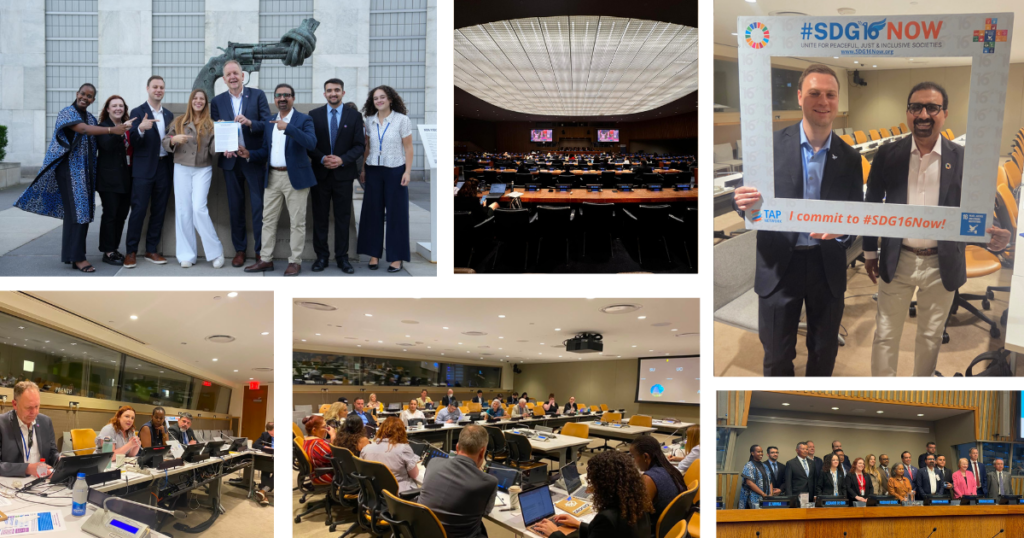
TAP Network at the 2026 SDG16 Conference and Civil Society Forum on SDG16+
By Malaika Walker and Elena Marmo, TAP Network Secretariat
In June 2026, the TAP Network attended the annual SDG16 Conference and co-organized a Civil Society Forum on SDG16+ alongside longtime TAP Partner, the Civil Society Platform for Peacebuilding and Statebuilding. The discussions across both days featured reflections by TAP Members and Partners, and a presentation of the Civil Society Declaration on SDG16+. Read on below for more information.
2026 Civil Society Forum on SDG16+
The 2026 SDG16 Civil Society Forum, hosted at the UN Headquarters in New York, brought together Civil Society Organizations from around the world to discuss the impact and future of Sustainable Development Goal 16. The forum provided a unique opportunity for the launch of the 2026 Civil Society Declaration on SDG16+, discussion on Civil Society strategies Beyond 2030, and notes on stocktaking to progress further action on the 2030 Agenda. As the TAP Network, we enjoyed the opportunity to engage our TAP Network Members & Partners throughout the forum, especially with two members of our steering committee, Leonie Mutoni and Zia Ur-Rehman, taking part in the day’s discussion.
The TAP Network, along with the Mission of Italy, IDLO, UNDESA, and Civil Society Platform for Peacebuilding and Statebuilding came together to make this forum a success that would go on to help inform the SDG16 Conference. Speakers both online and in person demonstrated the breadth and engagement of a diverse group of stakeholders and experts across the SDG16+ landscape. Civil Society colleagues spoke to issues of Peacebuilding and Conflict Prevention, Access to Justice and Legal Empowerment, Inclusion and Civic Space, and Democracy and People-centered Governance. SDG16’s interlinkages across the 2030 Agenda (in particular SDGs 3, 4, 5, 10, 13, and 17) were also highlighted by participants coming from adjacent fields and other communities of practice.
Interested in learning more and joining the #SDG16Now Campaign? Sign-up for our listserv here.
2026 Civil Society Declaration on SDG16+
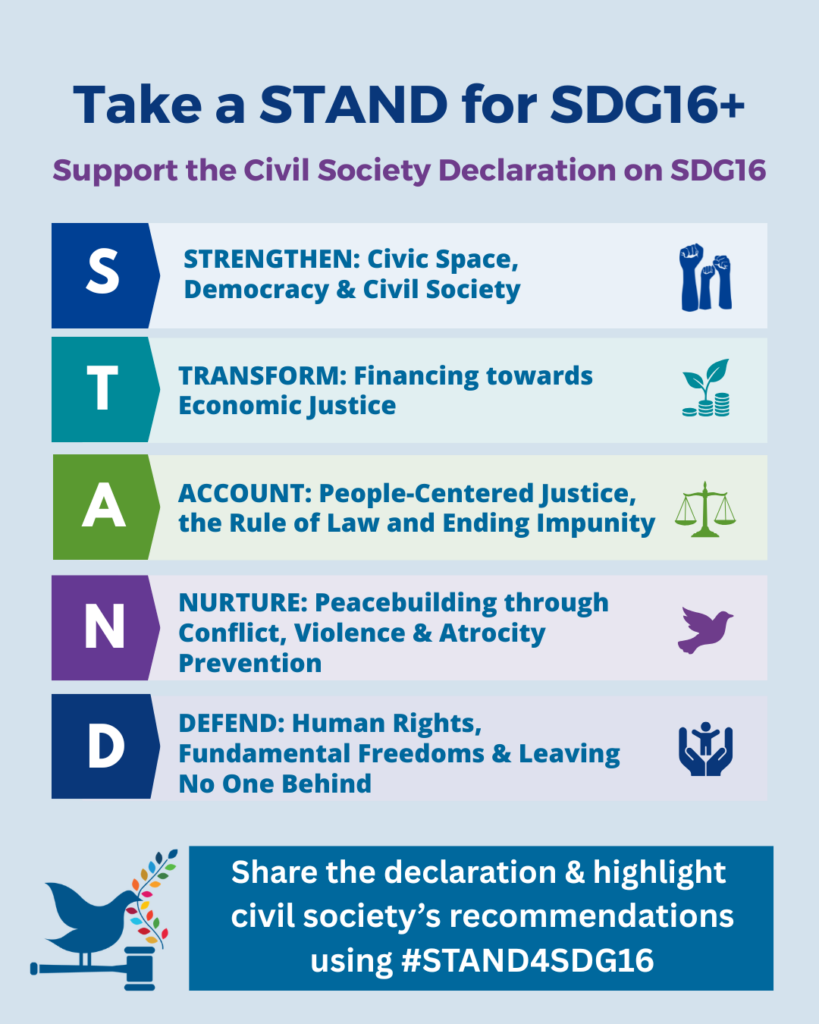
Much of the conversation throughout the day centered on the 2026 Civil Society Declaration on SDG16+. Crafted and contributed to by 225 NGOs, peacebuilders, justice workers, human rights defenders, activists, and communities across the world and over 450 endorsements, the STAND principles serve as a critical framework for assisting stakeholders in recognizing where to begin. STANDing for SDG16+ means turning commitments into action across the five interconnected priorities of this Declaration:
- Strengthening civic space, democracy, and civil society;
- Transforming financing systems towards economic justice;
- Account(ability) for people-centred justice and rule of law;
- Nurturing peacebuilding through conflict, violence, and atrocity prevention; and
- Defending human rights, fundamental freedoms, and inclusion
The declaration recognizes that the world today faces interconnected political, economic, climate, and governance catastrophes reinforce one another across borders. While SDG 16 serves as a fundamental opportunity to accelerate progress on peace, justice, and strong institutions, and, in turn, the achievement of all SDGs, this cannot be done without concrete commitments shaped by the perspectives of those on the frontlines.
Speaker Highlights
To open the Forum, Ms. Daniela Tonon, Minister Counsellor at the Permanent Mission of Italy to the United Nations, Mr. David LeBlanc, Division for Public Institutions and Digital Government, UNDESA, and Mr. Henk-Jan Brinkman, Permanent Observer IDLO to the UN shared their perspectives and commitments to advancing SDG16 and working with civil society actors in this regard.
The first panel led speakers Gina Romero, the UN Special Rapporteur on freedom of peaceful assembly and of association, Regina Portilla from Peace Direct, Akhila Kolisetty from Namati, Nick Zuroski from the Alliance for Peacebuilding, and Jesselina Rana from CIVICUS to explore how their different fields inform their approaches to the advancement of the 2030 Agenda through the lens of the STAND principles. The diverse perspectives linked the challenging realities in democratic advancement, conflict, and development work to realistic avenues for advancement.
In the second panel, on “Civil Society Strategy for Beyond 2030”, Arelys Bellorini from CEPEI highlighted both the reality of the challenges faced in implementing the 2030 Agenda, and the necessity of continuing to advance it while looking towards what will happen beyond 2030. She shared that looking at the 2030 Agenda with pessimism is “a political choice, not an analysis”, as no matter what, these goals are vital to humanitarian wellbeing. Harshani Dharmadasa from the UN Foundation built on this message by highlighting the way that internal shifts in the UN system provide opportunities for building on challenging discussions and asking questions that center relevant and long-term outcomes for future generations.
In the afternoon, speakers H.E. Baba Sillah, Deputy Permanent Representative of Liberia to the United Nations in New York, and Natalia Peláez Pérez from Fundacion LATIR, Leonie Mutoni, Coordinator of the African Center of Excellence for Access to Justice (ACE-AJ) Network, Vitorino Mello Oliveira, First Secretary at the Permanent Mission of Portugal, and Ajmal Ramyar from Afghans for Progressive Thinking outlined the ways that they have met and overcome challenges in their varying contexts. Civil Society speakers especially outlined the critical role that moral fortitude and financing play in continuing work of the SDGs despite growing backlash against grassroot actors.
Some of the salient elements coming from the dialogues included:
- The importance of accountability in the context of shrinking civic space and restrictions due to impact of fragility, conflict and violence.
- The acknowledgment of the importance of breaking down siloes and work better in a coordinated and collaborative way. And the necessity for funding to facilitate collaboration over competition.
- The recognition of the value of grounded narratives and the power of storytelling in meeting audiences where they are.
- The pivotal work done by grassroots actors and communities needs to be met with clear recognition and tailored (flexible, reliable and sustainable) support.
- And lastly, the importance of investing in pathways to instil and/or reinstate trust in institutions and structures at all levels to ensure we can deliver on the promises of the 2030 Agenda and other relevant commitments.
An important note: the 2026 Civil Society Forum and all that led up to it represents the TAP Network’s continued commitments to sustainable and collaborative partnership across fields. The importance of all of those who contributed to this event’s success cannot be understated and represents the importance of working with one another as a fundamental axis of not only advancement but wellbeing of the 2030 Agenda.
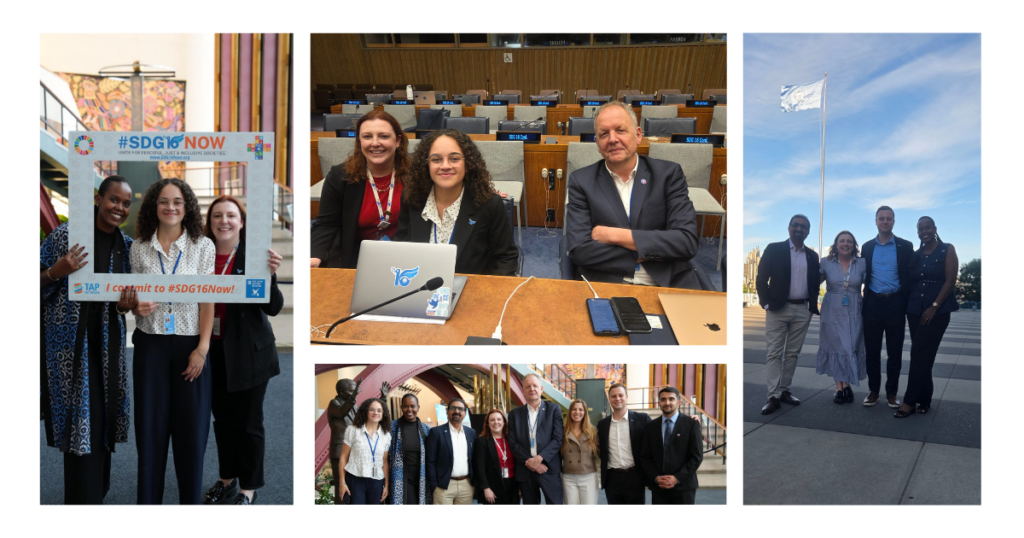
2026 Conference on Sustainable Development Goal 16
The 2026 Conference on Sustainable Development Goal 16 brought Member States, UN Staff, and Civil Society together for an array of panels that explored:
- Stocktaking progress on SDG16 and presentation of the 2026 Civil Society Declaration on SDG16+
- Peace, Justice, and effective institutions: the transformative impact of SDG16
- Partnerships and collective action to build peaceful, just and inclusive societies
The Conference, organised by the Government of Italy, IDLO, and UNDESA, with civil society speakers supported by the TAP Network and Civil Society Platform for Peacebuilding and Statebuilding. Speakers throughout the panels explored how elements of the Civil Society Declaration on SDG16+ are relevant to their work, and called on Member States to strengthen their commitment to the implementation of the entire 2030 Agenda.
As the first Civil Society speaker, Ajmal Ramyar of Afghans for Progressive Thinking launched the Civil Society Declaration on SDG 16+, outlining the five principles of the STAND acronym, and specifically highlighting the civic space crisis that exists. The CIVICUS Monitor found that only 7.2% of the world’s population lives in open civic space. The V-Dem Democracy Report tells us that 72% of the world’s population now lives under autocratic rule. Ajmal noted that human rights defenders, journalists, and community leaders face surveillance, legal repression, smear campaigns, and forced exile. This is not a trend confined to one region — it is global. For example, Ajmal noted that civic space has almost disappeared under the Taliban in Afghanistan, “We see voices silenced through bans on education, restrictions on movement, and constant threat to those who try to raise their voices.”
On Panel 1, Natalia Peláez Pérez of Fundación LATIR shared her experience working on the Youth, Peace and Security Agenda in Colombia, and went into increased depth on the STAND Principles, and in a powerful moment for the entire room, encouraged everyone to turn off their phones and laptops, take a deep breath, connect to what they value in SDG16, and envision what that would look like and the role they can play in making it happen. Following this reflection, Nataila led the room to STAND, “if you thrust in your own power and have the determination to make this imagined world a reality.”. In a system to sometimes looses its capacity for maintaining a focus in humanity and focus, this moment was a vital way to call attendees back to their individual connection to the work we have all elected to take part in. The power of small actions is instrumental in driving sustained trust and motivation towards action on SDG16+.
In Panel 2, Leonie Mutoni, Coordinator of the African Center of Excellence for Access to Justice (ACE-AJ) Network, and TAP Network Steering Committee Member spoke specifically on matters related to access to justice. Leonie specifically highlighted the concept of legal empowerment as a tool for closing the justice gap. She noted: “Often when we talk about access to justice, we tend to imagine the formal system: courts, judges, lawyers, prosecutors. But if you look at where people go when they have a legal problem, the picture looks very different. The reality on the ground, and research has consistently backed this up, is that most people’s search for justice does not begin in a courtroom. They seek assistance from paralegals in their village, community elders, local mediators, and informal customary structures. Because these structures are accessible, affordable and trusted. They also play a critical role in community legal empowerment.
I want to stress that legal empowerment is not an abstract concept! It is about giving ordinary people the knowledge, skills, and support to understand, use, and shape the laws that affect their lives.”
In panel 3, Zia Ur-Rehman, Director and Secretary-General of the Asia Development Alliance and TAP Network Steering Committee Co-chair, highlighted, given the trend of shrinking civic space, and funding challenges for civil society today, how participation and meaningful inclusion of civil society in governance and SDG implementation be strengthened through action on SDG 16. He provided practical recommendations including: “In short, strengthening civil society participation through SDG 16+ requires four actions: protect civic space, institutionalize participation, finance civil society resilience, ensure partnerships and multistakeholders engagements and last but not least ensure accountability for commitments. Without civil society, SDG implementation will remain incomplete; without civic space, accountability will remain weak; and without inclusion, strong institutions, meaningful partnerships and multistakeholder engagements the promise of the 2030 Agenda will remain out of reach.”
Looking Ahead
The 2026 Conference on Sustainable Development Goal 16 brought Member States, UN Staff, and Civil Society together to take stock of progress on SDG16 to date, and to identify transformative action to build more peaceful, just and inclusive societies.
The 2026 Civil Society Declaration on SDG16+ offers a clear roadmap with a comprehensive set of recommendations. As such, we reiterate: STANDing for SDG16+ means turning commitments into action across the five interconnected priorities of this Declaration:
- Strengthening civic space, democracy, and civil society;
- Transforming financing systems towards economic justice;
- Account(ability) for people-centred justice and rule of law;
- Nurturing peacebuilding through conflict, violence, and atrocity prevention; and
- Defending human rights, fundamental freedoms, and inclusion